Monitoring Server Health
Learn how to monitor your server's health and resource utilization on KloudBean. Keeping an eye on resource utilization is crucial to avoid resource congestion issues or production downtime.
Overview
KloudBean provides a user-friendly UI to view your server health and utilization of resources. It is important to keep an eye on resource utilization in order to avoid any resource congestion issues or production downtime. Regular monitoring helps you identify potential issues before they impact your applications and allows you to make informed decisions about scaling and optimization.
KloudBean's Optimized Infrastructure
KloudBean provides servers that are already best optimized, and you are having high-performance hardware. Complete stack components along with kernel parameters are optimized and tuned to give the best performance. However, each resource still has its limitations. If you are seeing resource consumption at a critical level, then ask KloudBean to scale up. If you see resources in a warning state, then consider optimizing your application code or plan to do some optimization, or plan to scale up in the near future.
Types of Monitoring
KloudBean provides two types of monitoring:
1. Server Health Status Page
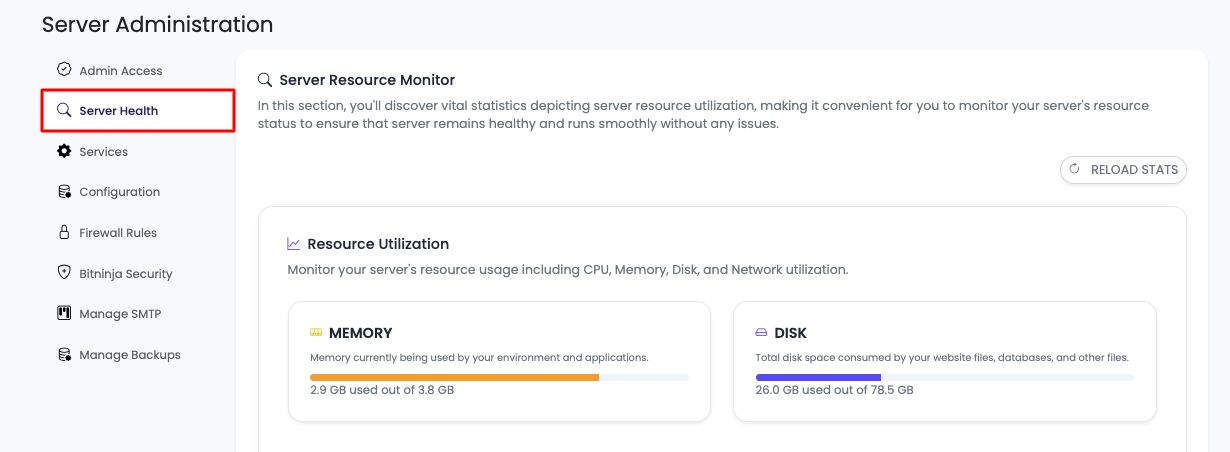
Navigate to server administration → "Server Health" to view real-time server health metrics and resource utilization. This provides a comprehensive visual dashboard of all critical server components.
2. Email Alerts
KloudBean sends email alerts when the server reaches critical limits. These alerts are automatically sent to your registered email address, ensuring you're immediately notified of any critical resource issues.
Accessing Server Health Monitoring
Step 1: Navigate to Server Health
To view your server health:
- Log in to your KloudBean dashboard
- Navigate to Server Administration: Open the server administration page for your desired server
- Go to "Server Health": Click on "Server Health" in the server settings menu
Step 2: View Complete Server Health Overview
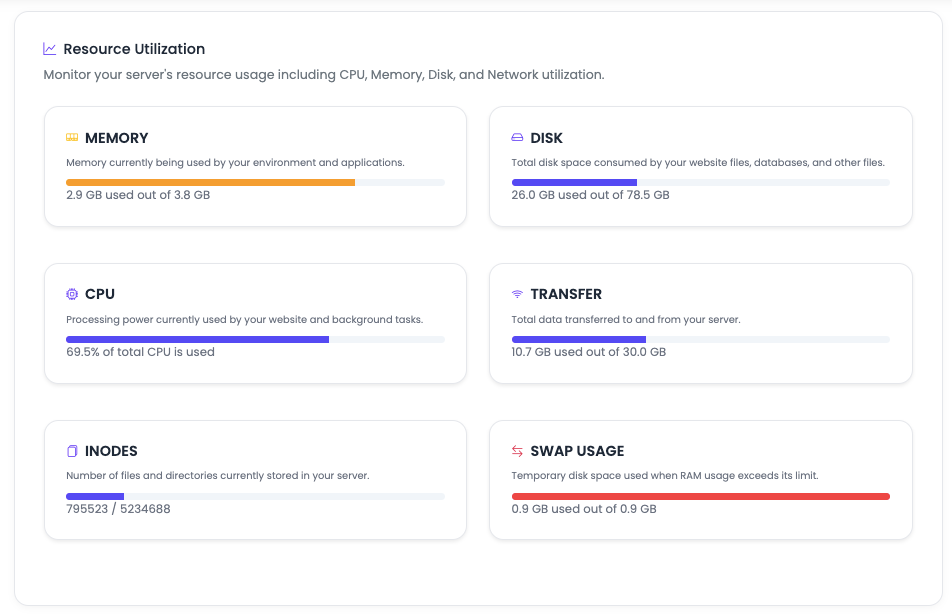
This section provides utilization stats for all critical components. Here is the complete view of server health:
Monitored Resources
KloudBean monitors all these resources and displays their utilization:
- MEMORY: RAM usage and availability
- DISK: Storage space and disk I/O
- CPU: Processor utilization and load
- DATA TRANSFERRED: Network bandwidth usage
- INODES: File system inode usage
- SWAP MEMORY: Virtual memory usage
Understanding Color Indicators
KloudBean uses color coding to quickly indicate resource status:
- Blue: Resources are in good condition, not much used. This indicates healthy resource levels with plenty of capacity available.
- Yellow: Warning state. Resources are approaching their limits, and you should monitor closely or consider optimization or scaling.
- Red: Critical condition. Resources are at or near their maximum capacity, and immediate action is required to prevent service disruption.
Viewing Detailed Resource Information
To view more detailed information about a particular resource:
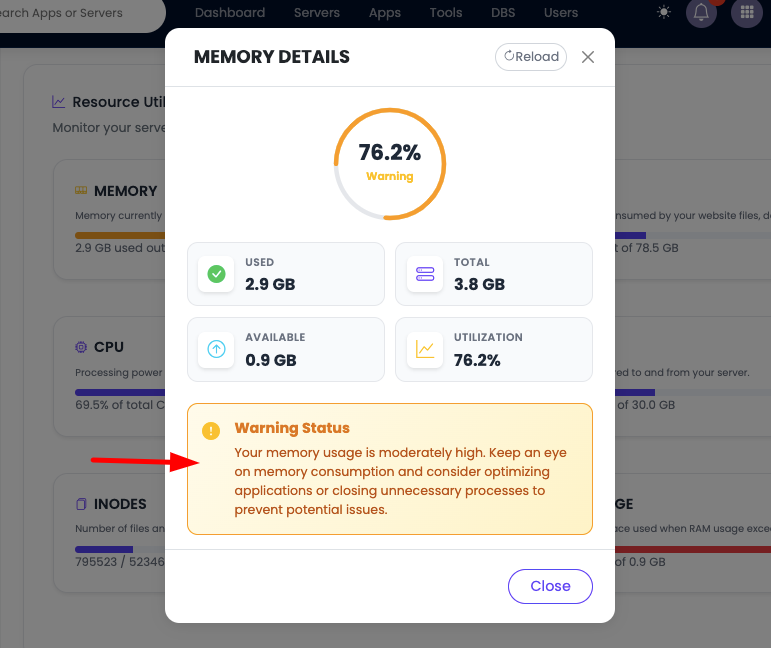
- Click on the Resource: Click on the specific resource card or section you want to examine
- View Detailed Metrics: You'll see expanded information.
Understanding Each Resource
Memory (RAM)
What It Is: Random Access Memory (RAM) is the primary storage for active data and running processes. It's much faster than disk storage and is used by the operating system and applications to store data that needs quick access.
Why Monitor Memory:
- Application Performance: Insufficient memory causes applications to slow down or crash
- System Stability: Low memory can cause system instability and unexpected shutdowns
- Swap Usage: When RAM is full, the system uses swap (disk-based memory), which is much slower
- Memory Leaks: Monitoring helps identify applications with memory leaks
- Capacity Planning: Understanding memory usage helps plan for future scaling
What to Watch For:
- Memory usage consistently above 80% indicates you may need more RAM
- Rapid memory growth may indicate a memory leak
- High swap usage means you're running out of physical RAM
- Memory spikes during peak traffic times
Recommendation: If you observe high memory utilization consistently, contact KloudBean to scale up your server's RAM. For warning levels, consider optimizing your application code to reduce memory footprint or plan for scaling in the near future.
Disk Storage
What It Is: Disk storage is where all your files, databases, logs, and application data are permanently stored. Unlike RAM, disk storage persists even when the server is powered off.
Why Monitor Disk:
- Storage Capacity: Running out of disk space can cause application failures and data loss
- Performance: Full disks significantly slow down read/write operations
- Database Health: Databases need adequate disk space for operations and growth
- Log Management: Log files can consume significant disk space over time
- Backup Space: Adequate disk space is needed for backups
What to Watch For:
- Disk usage above 80% requires attention
- Rapid disk space consumption may indicate log file growth or data accumulation
- Low disk space can prevent database operations
- Disk I/O performance degradation as disk fills up
Recommendation: If disk utilization reaches critical levels, contact KloudBean to scale up your storage. For warning states, consider cleaning up old logs, archiving old data, or planning for storage expansion.
CPU (Central Processing Unit)
What It Is: The CPU is the brain of your server, executing instructions and processing data for all running applications and system processes.
Why Monitor CPU:
- Application Performance: High CPU usage slows down all applications on the server
- Response Times: CPU bottlenecks cause slow response times for users
- Concurrent Processing: CPU capacity determines how many requests can be processed simultaneously
- Cost Efficiency: Understanding CPU usage helps optimize resource allocation
- Scaling Decisions: CPU metrics help determine when to scale up
What to Watch For:
- Sustained CPU usage above 95% indicates you need more processing power
- CPU spikes during specific operations may indicate optimization opportunities
- High CPU load averages suggest the system is overloaded
- CPU wait times indicate I/O bottlenecks
Recommendation: If CPU utilization consistently reaches critical levels, contact KloudBean to scale up your server's CPU resources. For warning states, consider optimizing your application code, database queries, or caching strategies before scaling.
Data Transferred (Network Bandwidth)
What It Is: Data transferred represents the amount of network traffic (incoming and outgoing) your server handles. This includes web requests, file transfers, API calls, and database replication.
Why Monitor Data Transfer:
- Bandwidth Limits: Exceeding bandwidth limits can result in additional charges or throttling
- Performance: High network usage can slow down application responses
- Traffic Patterns: Understanding traffic helps with capacity planning
- DDoS Detection: Unusual traffic spikes may indicate attacks
- Cost Management: Monitoring helps control bandwidth costs
What to Watch For:
- Sudden spikes in data transfer may indicate traffic anomalies
- Consistently high transfer rates may require bandwidth upgrades
- Incoming vs outgoing traffic patterns
- Peak usage times and trends
Recommendation: If data transfer consistently reaches limits, contact KloudBean to upgrade your bandwidth plan. Monitor traffic patterns to identify optimization opportunities like CDN usage or caching.
Inodes
What It Is: Inodes are data structures that store information about files and directories on your file system. Each file, directory, or symbolic link uses one inode.
Why Monitor Inodes:
- File System Limits: Running out of inodes prevents creating new files, even if disk space is available
- Small File Accumulation: Many small files can exhaust inodes quickly
- System Operations: Low inodes can prevent system updates and operations
- Application Failures: Applications may fail if they cannot create new files
- Email Systems: Email servers with many small messages are particularly susceptible
What to Watch For:
- Inode usage above 80% requires attention
- Rapid inode consumption may indicate an application creating too many files
- Many small files (like cache files, logs, or email messages) consume inodes quickly
- Inode exhaustion can occur even with plenty of disk space available
Recommendation: If inode usage reaches critical levels, contact KloudBean for assistance. Consider cleaning up unnecessary files, optimizing file creation patterns, or planning for inode capacity increases.
Swap Memory
What It Is: Swap memory is disk space used as virtual memory when physical RAM is full. The system moves less-used data from RAM to swap to free up RAM for active processes.
Why Monitor Swap:
- Performance Indicator: High swap usage indicates insufficient RAM
- Performance Degradation: Using swap is much slower than RAM, causing significant performance issues
- System Health: Excessive swap usage can indicate memory pressure
- Application Slowdown: Applications become very slow when swap is heavily used
- Disk I/O Impact: Swap usage increases disk I/O, affecting overall system performance
What to Watch For:
- Any significant swap usage suggests you need more RAM
- High swap activity (swapping in/out) indicates memory pressure
- Swap usage combined with high memory usage confirms RAM shortage
- Performance degradation correlates with swap usage
Recommendation: If swap memory is being used consistently, contact KloudBean to increase your server's RAM. Swap usage is a clear indicator that your server needs more memory resources.
Monitoring Via Email Alerts
KloudBean sends alerts if any resource utilization crosses the limit. Alerts are sent automatically to your registered email address.
Alert Thresholds
By default, these thresholds are set to trigger email alerts:
- CPU_THRESHOLD=95%: Alert when CPU usage exceeds 95%
- MEM_THRESHOLD=85%: Alert when memory usage exceeds 85%
- DISK_THRESHOLD=80%: Alert when disk usage exceeds 80%
How Email Alerts Work
- Automatic Monitoring: KloudBean continuously monitors all server resources
- Threshold Detection: When a resource exceeds its threshold, an alert is triggered
- Email Notification: An email is automatically sent to your registered email address
- Alert Details: The email includes:
- Which resource exceeded the threshold
- Current utilization percentage
- Recommended actions
- Server information
Responding to Alerts
Critical Alerts (Red):
- Immediate Action: Contact KloudBean support to scale up resources
- Investigation: Check what's causing the high utilization
- Temporary Measures: Consider temporarily stopping non-essential services
Warning Alerts (Yellow):
- Monitor Closely: Keep an eye on the resource usage
- Optimization: Consider optimizing your application code
- Planning: Plan for scaling in the near future
- Preventive Action: Take action before it becomes critical
Best Practices for Server Health Monitoring
Regular Monitoring
- Daily Checks: Review server health dashboard daily
- Weekly Reviews: Analyze weekly trends and patterns
- Monthly Analysis: Review monthly reports for capacity planning
- Alert Response: Respond promptly to email alerts
Proactive Management
- Address Warnings Early: Don't wait for critical alerts
- Optimize Before Scaling: Try optimization before scaling up
- Monitor Trends: Watch for gradual increases in resource usage
- Plan Ahead: Scale resources before reaching critical levels
Optimization vs Scaling
When to Optimize:
- Resources are in warning state (yellow)
- You can identify optimization opportunities in your code
- Performance issues are code-related, not resource-related
- You want to maximize current resource efficiency
When to Scale Up:
- Resources consistently reach critical levels (red)
- Optimization has been attempted but resources are still insufficient
- Traffic or workload has genuinely increased
- You need immediate capacity increase
Resource Planning
- Baseline Metrics: Establish normal baseline metrics for your server
- Growth Projections: Plan for future growth based on trends
- Peak Times: Identify peak usage times and plan accordingly
- Capacity Planning: Plan scaling before resources become critical
Troubleshooting Resource Issues
High Memory Usage
- Identify Processes: Check which processes are using the most memory
- Memory Leaks: Look for applications with continuously growing memory usage
- Optimize Applications: Review and optimize application memory usage
- Scale Up: Contact KloudBean to increase RAM if optimization isn't sufficient
High CPU Usage
- Identify CPU-Intensive Processes: Find processes consuming CPU resources
- Code Optimization: Optimize application code and database queries
- Caching: Implement caching to reduce CPU load
- Scale Up: Contact KloudBean to increase CPU resources if needed
High Disk Usage
- Identify Large Files: Find files consuming disk space
- Clean Up: Remove unnecessary files, logs, and temporary data
- Archive Old Data: Move old data to archival storage
- Scale Up: Contact KloudBean to increase disk storage
High Inode Usage
- Find File Sources: Identify directories with many small files
- Clean Up: Remove unnecessary files and directories
- Optimize File Creation: Review applications creating too many files
- Contact Support: Reach out to KloudBean for inode capacity solutions
KloudBean's Optimized Infrastructure
Pre-Optimized Servers
KloudBean provides servers that are already best optimized with:
- High-Performance Hardware: Latest generation processors and fast storage
- Optimized Stack Components: All software components are optimized for performance
- Tuned Kernel Parameters: System kernel is tuned for optimal performance
- Best Practices Applied: Industry best practices implemented by default
Performance Benefits
- Maximum Efficiency: Get the best performance from your resources
- Reduced Overhead: Optimized systems have lower overhead
- Better Resource Utilization: More efficient use of available resources
- Proven Configurations: Tested and proven optimal configurations
When Resources Still Have Limits
Despite optimization, each resource still has its limitations:
- Physical Constraints: Hardware has physical limits
- Workload Growth: Applications and traffic grow over time
- Resource Exhaustion: Even optimized systems can run out of resources
- Scaling Needs: Growth requires additional resources
Making Scaling Decisions
If you see resource consumption at a critical level (Red):
- Immediate Action: Contact KloudBean to scale up immediately
- Prevent Downtime: Scaling prevents service disruption
- Quick Resolution: KloudBean can help scale resources quickly
If you see resources in warning state (Yellow):
- Optimize First: Consider optimizing your application code
- Plan Optimization: Review code for efficiency improvements
- Plan Scaling: Plan to scale up in the near future
- Monitor Closely: Keep monitoring to prevent critical state
Next Steps
After monitoring your server health:
- Learn about Server SSH Access Control to secure server access
- Explore Updating Server Stack Settings to configure server components
- Review Managing Server Backups to protect your server data